Tuesday, July 14, 2009

Plate 141 - TG


Just to hand this week is this example of TG state 2 from plate 141 - the first example of this stamp I have seen.
It is shown with the imprimatur, as I don't yet have an original state print of this stamp.

The scan of this was very poor when I bought it, but this very distinctive worn orange colour had me thinking it was a later plate - actually I thought it was a late very worn state 1 from plate 157.

When it arrived I was surprised to find it had a TRL at right, and a quick check proved it was not 157 but 141.

The repair of this unit strengthens the right sideline and erases the sideline break just under the right star, that is seen on the imprimatur. A new TRL is seen adjacent.

Statham says that ONE PENNY is compressed, and this is difficult to see on this stamp due to its advanced state of wear, but I think this effect is most apparent on the NNY.

This is the only repair known from this plate.

Saturday, November 15, 2008

Plate 64 - BH


I haven't had anything to post on for a couple of months, but I recently found a very nice state 2 example of this stamp in a strip of five.
It's shown at bottom right above, together with two state 1s above and another state 2.

State 1 prints show what I would call a slight-to-medium strength upper border shift.
This effect is lessened by the repair.

Statham notes:
'BH is known with a strong TRL in the left margin. This suggests that it was repaired by re-entry, although there is no noticeable strengthening of the frame line or weakening of the check letters.'
I would agree that there is no apparent strengthening of the left side, but at right there is restoration of the small break at approximately 1 o'clock.

Repaired prints do not appear to be particularly scarce.

Friday, August 8, 2008

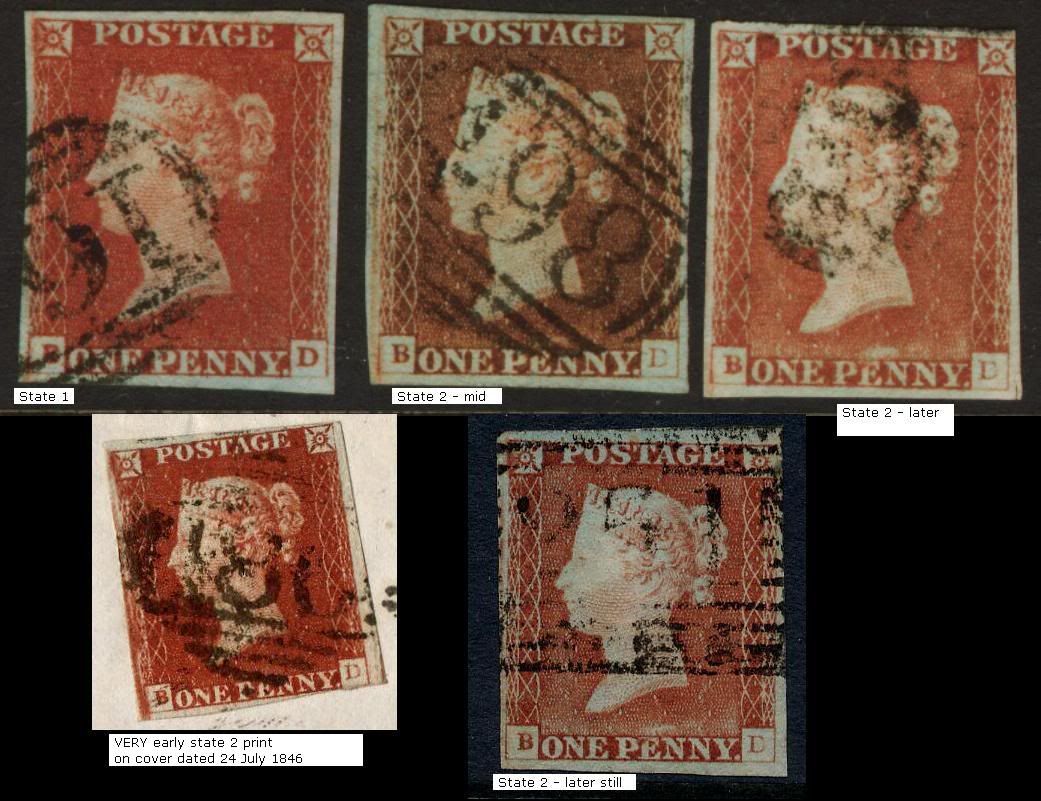
Plate 65 - BD


This is one of those few repairs that are seen in the second state quite frequently, but are very scarce or rare in the original state.
I have seen just two state 1 examples, yet at least 15 state 2s.

Prints of the repair are easily recognised by the markedly weakened checkletter D, and TRL in the left margin.
The repair was carried out so early that no worn state 1s have been seen; instead it is usual to see state 2s displaying quite a degree of plate wear.
Also there is a progressive patch of wear in the background directly above EN of PENNY, together with a mark inside the same E.
These are both easily seen on the image posted (click to enlarge).
The position of this patch of wear is quite unique - such patches of wear are usually seen in the adjacent right corner.

Wednesday, August 6, 2008

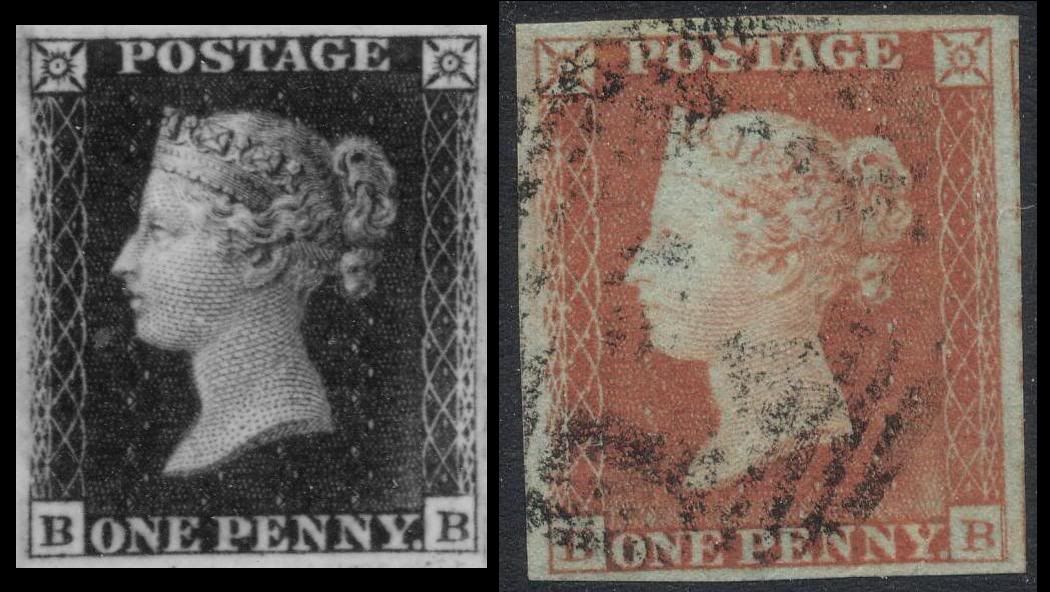
Plate 165 - BB


I recently located a imperforate state 2 example of this unit.
A very interesting stamp.

There is an illustration of a perforated vertical pair lettered AB-BB in GBJ Vol 3 No 4 Pg 58 (Oct 1961).
The text mentions duplication of the outer line of the SE corner on both stamps (more apparent on stamp BB), but doesn't mention that this is in the second state only.

The original state of this stamp displays very weak and broken left and right sidelines.
The lower half of the right side has been recut in an attempt to mitigate this.
However it is apparent that this recut does not follow the original line, and that it 'cuts in' resulting in the SE corner not being square.

In state 2, there is no apparent strengthening of the left side despite there being a weak TRL in the upper left margin.
The repair has restored the right side though, and the outer line of the second B square is duplicated.
It is apparent that the inner of these two lines is the original recut-out-of-plumb line of state 1.
This corner is now square.
The operation results in the second B being in a different postion than in state 1 - appearing more centrally placed - but it is in fact in exactly the same position relative to the original recut line.
There is some weakening of the checkletters, especially the lower part of the second B.

In Statham's description of this repair he says 'original recut of lower part of right frame line is no longer obvious'.
I would agree it's not obvious, however the line is still discernable in the outer side network, coming down to meet the innermost of the two lines on the outside of the SE square.
Statham also says 'TRL in right margin', but this is clearly not so in this stamp and nor is it in the illustration of the AB-BB pair mentioned above.

Saturday, July 19, 2008

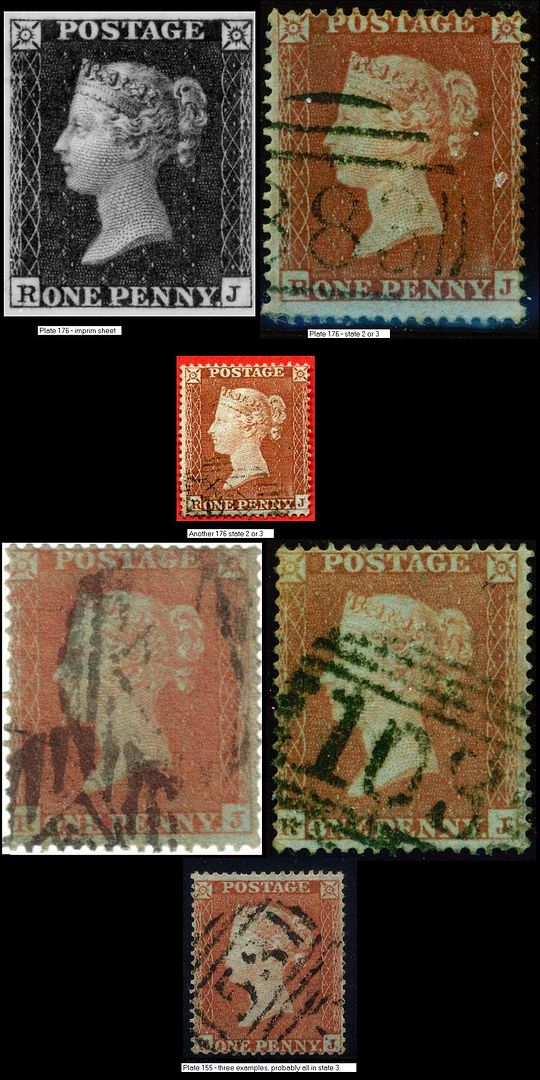
Plate 176 and 155 - RJ


Here is an interesting case.

Stamp RJ of plate 176 is one that has special mention in Statham.
He notes a non-coincident repair by re-entry, and illustrates the duplication of the outer line of the R square and of the major SW pointing ray of the right star.
Part of the commentary is 'R is closer to the right side of the square'.
What an understatement!

The illustration shows state 1 next to two repaired stamps.
The duplication is clear, especially on the example scanned larger.
The position of the checkletter R is significantly altered, and its tail is a completely different shape.
The checkletter J is also different.
It seems clear that both letters have been recut.
I am confident the allocation of these stamps to plate 176 is correct.

This unit is apparently known to have been repaired a second time.
For this reason I am unsure at this stage whether the two examples are state 2 or 3.
An interesting stamp - one to look out for.

Interestingly, I found both the scans of repaired stamps in places where they were described as plate 155.
Stamp RJ is missing from the 155 Imprimatur sheet, which doesn't help in identifying examples, but for the record I have included in the image above three examples of RJ from plate 155.
I suspect they are all state 3 prints, but the letter positions can be made out fairly well despite all three having cancels on top of them.

That two same stamps have been misplated as 155 makes me wonder if this is an error carried forward from another source.
Possibly the Gardner-Hill reconstructions had this wrong?

Thursday, June 26, 2008

Plate 8 of twopence blue - RK


Stamp RK of this plate is not listed by Osborne among the units to have had its plate number/s recut, that had become very broadened due to wear.
The many dated pieces Osborne lists as showing the recut are all dated from 13 November 1860.
This clearly dates the recutting operation to October or November 1860.

I have had this cover for about three years, dated July 1860.
The left plate number 8 displays as extremely broadened due to wear.
In my view this item proves that RK must also have been subject to hand retouch to thin the left plate number.
It would seem unusual for them have operated on other units around this area of the plate and leave RK, and I'm sure that they didn't.

I just need to find a later print to confirm this beyond doubt.

Wednesday, June 25, 2008

Plate 81 - TI


I have had a great deal of trouble finding examples of this stamp, despite it being quite a common plate.
I have had the crappy state 1 print for a couple of years, and have just located a state 2 example.

The repair to this stamp has been known for some time.
The repair is non-coincident resulting in duplication across its top, including the top line of the right star.
The major NE pointing ray in the NE square is clearly duplicated, and POSTAGE is compressed.
Duplication in the left star is also reported, but the cancel impedes in this example.
The checkletters display some weakening in comparison to state 1 prints.
There is a new TRL of medium strength running for virtually the full length of the left margin.

Originally I had thought this cover was dated 1848, but now to hand realise it's July 1849.
This is a couple of months after Statham's estimate of plate 81s withdrawal from press, and so this cover offers no clue as to when the re-entry may have been carried out.

This is the only example I have seen.